

Sandblasting in Phoenix: Methods, Media & When You Need It
Phoenix Sandblasting Guide
Sandblasting in Phoenix: What Property Owners Need to Know Before Hiring a Crew
Phoenix is hard on surfaces. UV, monsoon dust, alkaline soils, pool chemistry, rust, paint failure, and graffiti can all force property owners to strip surfaces down to bare substrate and start over the right way.
In This Guide
- Why Phoenix property owners search for sandblasting
- What sandblasting actually is
- Common blast media used in Phoenix
- Sandblasting vs. media, soda, and dustless blasting
- Seven common use cases across the Valley
- Mobile vs. shop sandblasting
- Silica, OSHA, lead paint, and hiring safely
- FAQs and quote checklist
Between UV that never quits, monsoon dust, alkaline soils, and pool chemistry that eats through coatings, almost every property in the Valley eventually needs something stripped down to bare substrate and rebuilt correctly. That is what sandblasting, more accurately abrasive blasting or media blasting, is built to do.
Whether you are a homeowner staring at a rusted patio set, a property manager dealing with fresh graffiti on a block wall, a pool builder prepping a deck for a new coating, or a plant manager trying to pass an SSPC inspection before a coatings vendor arrives, this guide explains what the process actually is, when it is the right call, and how to hire a crew that will not leave you with silica dust in your HVAC intake.
For a quick overview of scope and equipment, see Miracle Maintenance’s sandblasting services page and the companion media blasting Phoenix page.
What Sandblasting Actually Is
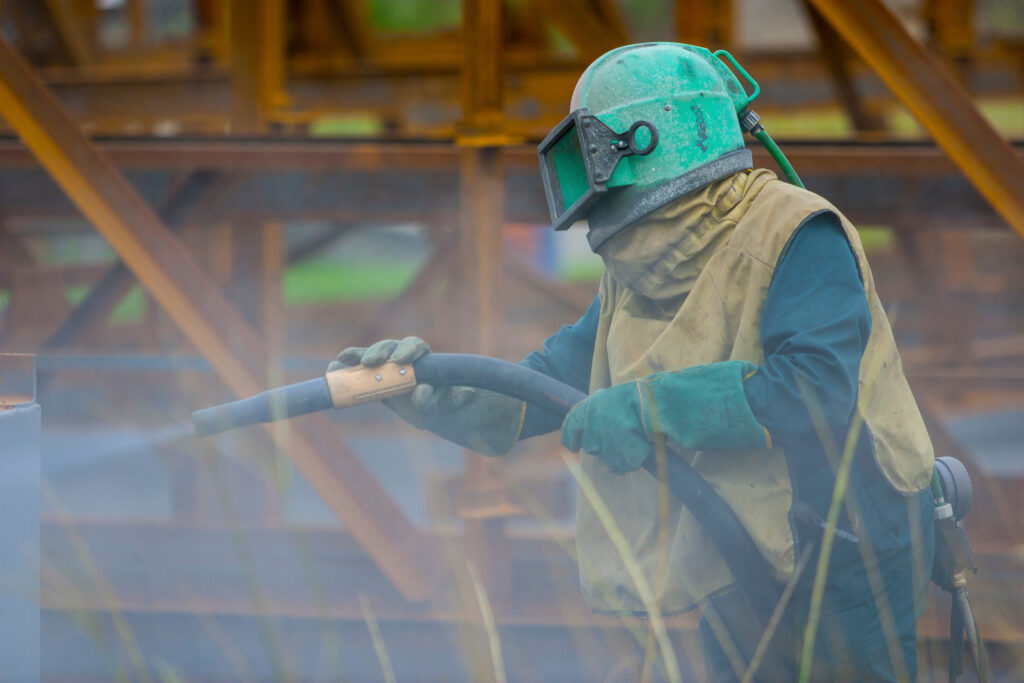
Sandblasting is the pressurized propulsion of an abrasive medium against a surface to remove coatings, corrosion, contaminants, or the surface layer itself. Compressed air, typically 90 to 150 PSI at the nozzle, accelerates the media through a blast pot and hose, while the operator controls impact energy through nozzle size, standoff distance, and dwell time.
The word “sand” is now largely a category name. Actual silica sand has been phased out of most professional work because of respirable crystalline silica exposure. Modern crews carry a range of media and choose based on the substrate, the coating being removed, containment requirements, and the surface profile the next coating needs.
Miracle Maintenance has been running abrasive and pressure-blasting equipment across the Valley for years. What matters most is matching the media, pressure, containment, and prep standard to the surface.
Common Blast Media Used in Phoenix
| Media | Best For | Aggression | Notes |
|---|---|---|---|
| Coal slag / Black Beauty | Structural steel, rust, thick industrial coatings | High | Workhorse for heavy rust and mill scale; single-use media. |
| Garnet | SSPC-spec surface prep, tanks, high-recyclability jobs | Medium-High | Low dust, cleaner profile, often reusable for 3 to 5 cycles. |
| Aluminum oxide | Hardened steel, aluminum, precision surface profiling | High | Sharp and angular; used for tight profile specifications. |
| Glass bead | Aluminum, stainless, chrome, restoration | Low-Medium | Creates a peening finish and preserves dimensional tolerance. |
| Crushed glass | Concrete, brick, log cabins, softer substrates | Medium | Silica-free, low embedment, and useful for restoration work. |
| Sodium bicarbonate / soda | Delicate substrates, fire soot, food-plant equipment | Very Low | Water-soluble and will not damage glass or trim. |
| Walnut shell / corn cob | Wood, log restoration, historical work | Very Low | Organic, biodegradable, and helpful for preserving patina. |
| Steel shot / grit | In-shop profiling, deep cleaning | High | Shop-based media that can be recycled continuously. |
Sandblasting vs. Media Blasting vs. Soda Blasting vs. Dustless Blasting
These terms are often used interchangeably in Phoenix searches, but they describe different processes with different use cases. Miracle offers each as a distinct service, including dedicated soda blasting for delicate substrates.
| Method | How It Works | Best Use | Trade-Off |
|---|---|---|---|
| Traditional dry sandblasting | Compressed air propels abrasive in an open blast setup. | Structural steel, industrial work, and tanks. | Silica risk if wrong media is used, with a heavy dust cloud. |
| Media blasting | Same equipment, with abrasive selected for the substrate. | Most commercial and restoration work. | Specialty media can increase project cost. |
| Soda blasting | Sodium bicarbonate crystals shatter on impact. | Kitchen equipment, fire restoration, and thin coatings. | Not aggressive enough for heavy rust. |
| Dustless / vapor blasting | Water is injected into the abrasive stream. | Occupied buildings, HOA properties, and areas near landscaping. | Slower process that generates slurry. |
For most Phoenix residential and light-commercial work, dustless blasting with crushed glass or garnet is the current sweet spot. It suppresses most airborne dust, keeps neighbors happier in dense Valley subdivisions, and avoids scattering media across a landscaped yard.
When You Need Sandblasting in Phoenix
Rust Removal on Steel and Wrought Iron
Phoenix backyards are full of wrought-iron pool fencing, view fencing, patio covers, and gates. Once rust breaks through the powder coat, wire-wheeling only pushes the problem under the next layer of paint. Blasting takes the steel back to bare metal so a new zinc-rich primer and finish coat can bond, which is the same workflow behind Miracle’s painting and staining service.
Paint Stripping
Multi-layer paint on block walls, stucco, or steel can hide substrate damage and prevent proper adhesion of a new system. Blasting removes every layer at once, including coatings that may need special handling on older structures.
Pool Deck and Cool Deck Prep
Before a new pool deck coating, acrylic overlay, or Kool Deck resurface can bond, the existing surface has to be profiled, not just cleaned. Light abrasive blasting opens the pores of the concrete without over-etching, giving the new coating a mechanical key.
Graffiti Removal
Property managers in Central Phoenix, Downtown, and along the light-rail corridor deal with graffiti constantly. On block walls, stone veneer, and painted stucco, chemical strippers often leave a ghost. Media blasting removes both the tag and its shadow in a single pass. See Miracle’s graffiti removal service for typical response and containment options.
Industrial Equipment, Tanks, and Fleet
Trailers, tanks, structural steel, and heavy equipment that need to be recoated to a specific SSPC standard cannot be prepped casually. Coatings vendors may refuse to warranty a finish that was not blasted to spec. Miracle’s tank and metal blasting crew handles this work across the Valley and out to industrial sites in Casa Grande, Buckeye, and the West Valley.
Log Cabin and Wood Restoration
Cabins in Prescott, Payson, and the Rim Country are typically blasted with crushed glass or walnut shell to strip old stain and UV damage without gouging the wood grain. Phoenix crews with mobile rigs handle these jobs in the field through services like wood restoration.
Concrete Cleaning, Profiling, and Contractor Prep
Warehouse floors, loading docks, and parking structures being prepped for epoxy, urethane, or polyaspartic coatings need the right concrete surface profile. For post-construction cleanup and new-build prep, Miracle’s pressure washing crews often run alongside the blasting team.
Mobile vs. Shop Sandblasting
Miracle runs both mobile rigs and shop capacity, and the right choice depends on what you are blasting.
Choose Mobile When
- The item is attached to the property, such as fencing, walls, structures, or pool decks.
- The equipment is too large to transport, including tanks, trailers, and industrial frames.
- You need same-day turnaround and cannot afford transport time.
- The site allows containment or a dustless setup.
Choose Shop When
- The item is portable, such as patio furniture, gates, automotive parts, or small equipment.
- You need a high-spec profile that requires controlled conditions.
- The finish coating will be applied in-shop right after prep, avoiding flash rust.
- Neighbors, tenants, or landscaping make on-site blasting impractical.
Silica, OSHA, and Why This Is Not a DIY Job
The single biggest change in the sandblasting industry over the last decade is enforcement of the OSHA respirable crystalline silica standard for construction. Any crew using true silica sand, or generating silica dust from concrete, brick, or masonry substrates, is required to control exposures and implement a written exposure control plan.
In practical terms, a legitimate Phoenix blasting contractor should be able to explain safety controls before work begins. That includes the media being used, respirator requirements, containment methods, and insurance coverage for abrasive blasting.
- Carry a written exposure control plan and be able to provide it.
- Use silica-free media such as garnet, coal slag, or crushed glass on most work.
- Provide supplied-air respirators for operators, not simple dust masks.
- Set up wet methods or containment when blasting concrete, brick, block, or stucco.
- Carry general liability and workers’ compensation insurance rated for abrasive blasting.
- Identify potential lead-based paint issues on pre-1978 structures before stripping.
If a bidder does not mention any of this and their quote is far below everyone else, that is usually the reason. Renting a blast pot to strip a fence also carries the same health risks. Respiratory exposure does not care whether the person operating the equipment is being paid.
SSPC Surface Prep Standards: What the Numbers Mean
If your project involves a coatings vendor, engineer, or inspector, you may see references to SSPC surface preparation standards. These specify how clean and how profiled a steel surface must be before a coating is applied. Getting this wrong is one of the fastest ways to void a coating warranty.
| Standard | Description | Typical Use |
|---|---|---|
| SP-1 | Solvent cleaning that removes oil, grease, and contaminants. | Prerequisite for every other specification. |
| SP-2 / SP-3 | Hand or power tool cleaning. | Small touch-ups and tight-budget work. |
| SP-6 | Commercial blast with most visible contaminants removed. | Most commercial atmospheric service. |
| SP-7 | Brush-off blast that removes loose material only. | Recoating tight, sound existing coatings. |
| SP-10 | Near-white metal cleaning. | Tanks, immersion service, and harsh environments. |
| SP-5 | White metal cleaning with no shadow. | Pharmaceutical, potable water, and extreme service. |
For most Valley commercial work, SP-6 is the practical sweet spot: aggressive enough to satisfy a coating warranty, without the added time and media cost of a near-white or white-metal blast. Immersion service, including potable water tanks, wastewater equipment, and chemical storage, is where SP-10 and SP-5 become non-negotiable.
How to Hire a Phoenix Sandblasting Contractor
Use this as a screening checklist before you request a site visit. A legitimate operator should be able to answer each of these without hesitation.
- Are you licensed with the Arizona Registrar of Contractors, and can I have your ROC number?
- Do you carry general liability and workers’ comp, and can you email current certificates of insurance?
- What media do you use for a job like mine, and why that one?
- Do you have a written silica exposure control plan?
- Is this quote for open blasting or dustless / contained blasting?
- If SSPC-spec: what standard are you blasting to, and how will you verify the profile?
- How do you handle cleanup and spent-media disposal?
- What is the warranty on the prep work if a coatings vendor is applying the finish?
- Can you show me three recent Phoenix-area jobs like mine with photos and references?
- Are you RRP-certified for pre-1978 structures that may contain lead paint?
Miracle Maintenance carries AZROC 296901 for mobile sandblasting and AZROC 340099 for painting and staining. Every quote names the specific media, containment plan, and prep standard the crew will work to.
Frequently Asked Questions
What is the difference between sandblasting and media blasting?
Media blasting is the umbrella term. Sandblasting historically referred to using silica sand as the abrasive, but modern crews use silica-free media such as garnet, crushed glass, coal slag, soda, and walnut shell matched to the substrate and coating being removed. In current usage, the terms are often interchangeable, but professional bids should name the actual media.
How long does a sandblasting project take?
A typical residential wrought-iron fence run takes half a day to a full day. A pool deck prep is usually 4 to 8 hours. Commercial structural steel is quoted by square foot per crew-hour, depending on coating thickness, access, containment, and SSPC standard.
Is sandblasting safe around a pool or landscaping?
Yes, if the crew uses dustless or vapor blasting with silica-free media and proper containment. Open blasting near landscaping, pool equipment, or HVAC intakes is not appropriate and should be avoided in Phoenix backyards.
Do I need to pull a permit for sandblasting in Phoenix?
Residential sandblasting typically does not require a permit. Commercial work involving lead paint, containment structures, or coatings for regulated equipment may trigger additional requirements. A licensed contractor should identify those issues during the site visit.
Can sandblasting damage the surface underneath?
Aggressive media on soft substrates can cause damage, including wood grain gouging, concrete over-etching, or aluminum warping. This is why matching the media to the substrate matters and why professional bids specify the abrasive rather than only saying “sandblasting.”
Does Miracle Maintenance offer dustless blasting for HOA and residential neighborhoods?
Yes. Dustless setups with silica-free media are the preferred recommendation for HOA-controlled properties and dense Valley subdivisions such as Ahwatukee, North Scottsdale, Gilbert, and Chandler. Details on scope and scheduling are available on the sandblasting and media blasting service pages.
Ready to Get a Sandblasting Quote?
Miracle Maintenance handles residential, commercial, and industrial abrasive blasting across the Phoenix Valley, from wrought-iron gates in Arcadia to structural steel in Deer Valley to graffiti removal along the Metro Light Rail corridor. Every quote includes the media, the surface prep standard, and the safety plan up front.




No Comments
Sorry, the comment form is closed at this time.