


Sandblasting vs. Soda Blasting vs. Dustless Blasting (2026)
Sandblasting vs. Soda Blasting vs. Dustless Blasting: How to Choose the Right Media for Your Surface (2026 Arizona Guide)
Almost every blasting job that goes wrong goes wrong at the same decision point. Someone picks the machine first and the media second. What strips the coating, protects the substrate, and decides whether the surface is ready for paint is the combination of abrasive media, air pressure, nozzle distance, and operator control.
This guide compares the media Miracle Maintenance uses in the field, matches each one to the surfaces it belongs on, explains the equipment behind sandblasting, soda blasting, and dustless blasting, covers what drives the cost of a job, and gives you the questions to ask before you hire anyone.
By the Miracle Maintenance crew. We are a Phoenix based sandblasting, soda blasting, dustless blasting, pressure washing, and surface restoration company, licensed and insured in Arizona, running our own blast pots and towable compressors.
Every job described below is work we perform in house on commercial buildings, structural steel, masonry, wood, and vehicles across the Valley, not subcontracted out.
The guidance here comes from what those surfaces actually do under a nozzle.
In This Guide
- What abrasive blasting actually does
- The media comparison table
- Soda blasting explained
- Dustless blasting and wet blasting explained
- The equipment behind the work
- Buying or renting your own blaster
- Surface by surface media selection
- Powder coating and hard coatings
- Wood, timber, and log surfaces
- Graffiti removal and soft surfaces
- Common blasting mistakes
- What drives the cost
- Shop blasting vs. mobile blasting
- Frequently asked questions
Key Takeaways
- Media hardness on the Mohs scale, not machine brand, decides whether a surface survives the job.
- Soda blasting uses sodium bicarbonate, one of the softest common media, and is suited to aluminum, sheet metal, wood, and many masonry surfaces.
- Dustless blasting suppresses airborne dust at the nozzle, which makes occupied commercial sites and tight neighborhoods more workable.
- Silica sand is a media to move away from because respirable crystalline silica is federally regulated and safer alternatives are available.
- A soda blaster is only as good as the air compressor behind it.
- Bare steel has a short coating window and can begin flash rusting the same day it is blasted.
- Cost is driven by surface area, coating layers, substrate sensitivity, containment, and access.
What Abrasive Blasting Actually Does
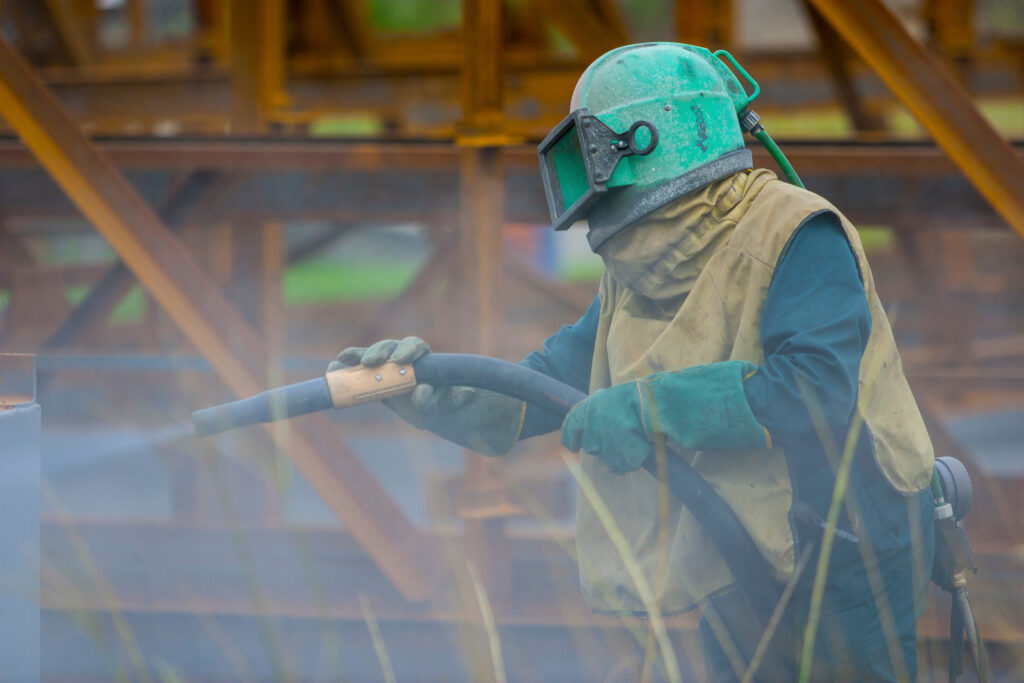
Abrasive blasting propels a media stream at a surface using compressed air. Harder media fractures and cuts the coating away and leaves a roughened profile called an anchor pattern. Softer media, such as sodium bicarbonate, shatters on impact and lifts the coating with released energy while leaving the substrate essentially unchanged.
That distinction matters because coating specifications often ask for both a defined degree of cleanliness and a measured surface profile. Soda blasting produces almost no profile, which is exactly right for a car body and exactly wrong for a tank that needs a high performance coating profile.
Hardness and the Mohs Scale
The Mohs scale ranks mineral hardness from talc at 1 to diamond at 10. Sodium bicarbonate sits near 2.5. Aluminum is roughly 2.5 to 3. Mild steel is around 4 to 4.5. Glass bead lands near 5.5, crushed glass near 6, and mineral and slag abrasives commonly run 7 or higher.
Media Type and Hardness
Sets how aggressively the coating and substrate are cut.
Air Pressure at the Nozzle
The fastest variable to turn into damage on thin or soft material.
Nozzle Distance and Angle
Controls how much energy reaches the surface and whether the stream cuts or feathers.
Operator Control
The difference between a controlled strip and a gouge, halo, or warped panel.
The Media Comparison Table
| Media | What It Strips | Aggressiveness | Surface Risk | Dust and Containment |
|---|---|---|---|---|
| Mineral and slag abrasives | Heavy rust, mill scale, industrial coatings | High | Etches soft metals and erodes masonry | High dust, full containment needed |
| Sodium bicarbonate | Paint, grease, smoke residue, light oxidation | Low | Very low; alkaline residue must be rinsed | Moderate dust, water soluble cleanup |
| Glass bead | Light coatings, oxidation, surface finishing | Low to medium | Can peen and work harden thin metal | Moderate dust, dry collection |
| Crushed glass | Coatings and rust on steel, concrete prep | Medium to high | Too sharp for soft substrates | High dust, silica free |
| Walnut shell and organic media | Delicate coatings, carbon, log and timber cleaning | Very low | Almost none; can embed in soft wood | Low dust, biodegradable |
| Dustless blasting | Same range as the dry media it carries | Matches media used | Flash rust on bare steel | Lowest airborne dust; runoff must be managed |
Soda Blasting Explained
Soda blasting uses sodium bicarbonate sized and hardened for blast use. It has a Mohs hardness around 2.5, which places it below aluminum, below mild steel, and below most masonry. That single number explains much of what soda blasting is good at.
Blast grade sodium bicarbonate is screened to a controlled particle size, treated with a flow agent so it does not clump in humidity, and produced in grades matched to different jobs. Kitchen baking soda is not a reliable substitute.
Automotive Sheet Metal
Useful where heat and impact from harder media can warp panels.
Aluminum and Soft Metals
A better fit where harder abrasives would etch or distort the surface.
Wood Beams and Timber
Lifts finish without aggressively opening the grain.
Brick, Block, and Stone
Useful where harder media could erode mortar joints or the face of the unit.
Fire and Smoke Restoration
Cleans while helping neutralize odor.
Non-Sparking Applications
Sodium bicarbonate is non sparking and non conductive.
Where Soda Blasting Falls Short
- Heavy rust and mill scale. Soda lifts coatings but does not cut thick oxide layers efficiently.
- Jobs that require a measured anchor profile. Soda does not profile steel the way harder abrasives do.
- Surfaces that cannot tolerate alkaline residue. Proper rinsing is part of the process before recoating.
Soda residue is water soluble, which simplifies cleanup, but the alkalinity still matters. The substrate and surrounding area should be rinsed before a new coating system is applied.
Dustless Blasting and Wet Blasting Explained
Dustless blasting introduces water into the media stream either in the pot or at the nozzle. The water adds mass to the particles and captures much of the fine dust that would otherwise become airborne.
In practical terms, this is what makes occupied commercial buildings, strip centers, and close residential work more manageable.
Airborne Dust
Wet delivery dramatically reduces the respirable dust cloud around the work.
Operator Visibility
A cleaner sight line improves control and reduces overblast on adjacent surfaces.
Runoff
Water and spent media still have to be contained, collected, and disposed of correctly.
Flash Rust
Bare steel can oxidize quickly after wet blasting, so inhibitor or immediate coating is critical.
Media Choice
Dustless blasting is a delivery method, not a specific abrasive. The media still has to match the substrate.
The Equipment: Blast Pot, Soda Blaster, and Air Compressor
Blast Pot
A pressurized vessel that holds abrasive and meters it into the air stream. Pressure pots provide the production rate needed for commercial work.
Siphon or Gravity Feed Units
Cheaper and much slower, making them better suited to small parts and cabinet work.
Wet or Dustless Units
Blast systems that meter water into the stream for dust suppression.
Dedicated Soda Units
Purpose built to handle low density sodium bicarbonate with better vibration, metering, and moisture control.
Blast Cabinets
Enclosed shop units with media recovery, ideal for small parts and repeatable finishing.
Why a Soda Blaster Is Built Differently
Sodium bicarbonate is light and hygroscopic, so it bridges and clumps in a pot designed for heavier mineral abrasive. A purpose built soda blaster uses vibration or agitation, media metering tuned to low density material, and moisture control through the air path.
The Air Compressor Is the Real Bottleneck
A blast nozzle consumes a specific volume of air at a specific pressure. If the compressor cannot sustain the required cubic feet per minute, nozzle pressure collapses and the strip rate falls sharply.
Small hobby systems can run in short bursts. Production nozzles typically require a towable diesel compressor, which is why mobile crews arrive with one on the trailer.
Buying or Renting Your Own Blaster
Handheld and Portable Soda Units
Useful for small parts, wheels, motorcycle frames, and spot work, but limited by hopper capacity and air supply.
Conversion Kits
Can work for occasional projects, but blast grade media and dry air are still essential.
Trailer Mounted Dustless Systems
True production equipment designed for contractors and commercial work.
Blast Cabinets
Best when parts are small enough to bring to the equipment instead of the equipment going to the site.
- Anything over a few hundred square feet.
- Occupied commercial sites where containment and runoff collection are compliance requirements.
- Sensitive substrates such as historic masonry, thin sheet metal, or coated aluminum.
- Work above ground level or in confined spaces.
- Any project with a coating specification that has to be verified.
Surface by Surface: Which Media Belongs Where
| Substrate | Recommended Media | Avoid | Why |
|---|---|---|---|
| Structural steel, tanks, trailers | Mineral, slag, or crushed glass | Soda | Needs a measured anchor profile for the coating system |
| Automotive bodies and frames | Soda or fine crushed glass at low pressure | Aggressive mineral abrasive | Thin panels can warp from heat and impact |
| Wheels and powder coated parts | Glass bead or fine mineral in a shop setting | Coarse abrasive at high pressure | Preserves edges and machined surfaces |
| Aluminum and soft metals | Soda or walnut shell | Steel grit or coarse mineral | Harder media can embed and etch the surface |
| Wood beams, timber, log homes | Soda or walnut shell | Hard mineral abrasive | Hard media tears out softer spring grain |
| Block, brick, and stucco | Soda at low pressure | Crushed glass and coarse mineral | Mortar joints and unit faces can erode first |
| Concrete and pool surfaces | Crushed glass or dustless blasting | Soda for profiling | Concrete prep requires real profile, not just cleaning |
Removing Powder Coating and Hard Coatings
Powder coating is a thermoset finish and does not behave like ordinary paint. Chemical strippers can soften it unevenly, creating more work rather than less.
Steel Parts
Aggressive media blasting removes the coating and creates the profile the new finish needs.
Aluminum Wheels and Trim
Finer media at controlled pressure protects machined surfaces and dimensions.
Warping
Oil canning or visible ripples can appear when thin panels are overheated or overworked.
Pitting and Edge Damage
Hazy texture, rounded edges, softened lettering, and embedded media are signs of overly aggressive blasting.
Soda Blasting Wood, Timber, and Log Surfaces
Soda blasting wood is one of the clearest cases where media hardness decides the outcome. Hard mineral abrasives remove soft spring grain faster than harder summer grain and can leave a washboard texture that is difficult to correct.
Log Homes and Timber Frames
Useful for removing failed stain, mildew, and weathered material without aggressively changing the log profile.
Exposed Beams and Vigas
A good fit for Arizona ranch and territorial style structures.
Fire and Smoke Restoration
Soda can remove soot and char while helping neutralize odor.
Decks and Shade Structures
Useful when old finish must be removed before a new sealer is applied.
Graffiti Removal and Soft Surfaces
Graffiti removal is its own category because the underlying surface is often softer than the paint sitting on top of it. Painted block, stucco, brick, signage, glass, and powder coated metal can all be damaged by overly aggressive media.
Soda blasting is frequently useful because it can lift paint while helping preserve mortar joints, stucco texture, and the original finish.
The Mistakes That Ruin a Blasting Job
Pressure and Technique
Running excessive pressure on thin sheet metal, holding the nozzle in one place, or blasting perpendicular to a soft substrate can warp, gouge, or embed media.
Site Conditions and Containment
High wind, poor masking, and unmanaged wet blast runoff can damage adjacent surfaces and create cleanup or compliance problems.
The Steps After the Blast
Missing the coating window, leaving soda residue, or failing to verify cleanliness before primer can undo an otherwise successful blast.
What Drives the Cost of a Blasting Job
There is no honest flat rate for blasting because a quote is built around measurable job conditions.
- Total surface area and the geometry of that area.
- Coating type and how many layers are on the surface.
- Substrate sensitivity and the pressure the surface can tolerate.
- The cleanliness standard required.
- Containment requirements, including scaffolding, shrouding, negative air, and runoff collection.
- Access, including height, confined space, and whether equipment can reach the work.
- On site work versus shop work.
- Turnaround requirements and crew size.
Shop Blasting vs. Mobile Blasting on Site
Shop blasting gives you a controlled booth, full media recovery, consistent lighting, and an immediate coating environment. For wheels, parts, frames, railings, gates, and anything that can be transported, the shop is usually the cleaner and more repeatable option.
Mobile blasting exists because structures do not move. Building exteriors, tanks, structural steel already in place, pool surfaces, block walls, and commercial equipment have to be treated where they stand.
What to Ask Before Hiring a Blasting Contractor
- What media are you using on my substrate, and why that one instead of the alternatives?
- What is your containment plan, and who handles the spent media and runoff?
- What cleanliness standard will the surface meet, and how will you verify it?
- How are you protecting adjacent surfaces, glass, seals, and landscaping?
- What is the window between blasting and coating, and who is responsible for meeting it?
- What size air compressor and nozzle will be on site?
- Are you licensed and insured for this scope in Arizona?
- Have you done this substrate before, and can you show the result?
Frequently Asked Questions
What is soda blasting?
Soda blasting is abrasive blasting using sodium bicarbonate media. The particles shatter on impact and lift coatings without aggressively cutting into the substrate, which makes the process useful on sheet metal, aluminum, wood, and masonry.
Is soda blasting better than sandblasting?
Neither is better in every situation. Soda is better when the substrate is soft, thin, or should not be profiled. Harder abrasive is better for heavy rust, mill scale, and coating systems that require a measurable anchor profile.
Can I use regular baking soda in a soda blaster?
Not reliably. Kitchen baking soda has no flow agent and absorbs moisture easily. Blast grade sodium bicarbonate is screened to a controlled particle size and treated to flow consistently through blasting equipment.
What size air compressor does a soda blaster need?
That depends on nozzle size. Sustained cubic feet per minute matters more than peak pressure. Small handheld units can run briefly on a large shop compressor, while production nozzles normally require a towable diesel compressor.
What does sandblasting cost depend on?
Surface area, geometry, coating layers, substrate sensitivity, required cleanliness standard, containment, access, and whether the work is performed on site or in a shop are the main variables.
Can blasting remove powder coating?
Yes. Media blasting is one of the most reliable ways to remove powder coating. On steel parts a more aggressive abrasive may be appropriate, while aluminum wheels and trim usually call for finer media at controlled pressure.
Will blasting warp sheet metal?
It can. Excess pressure, heat, and dwell time are the common causes. Soda blasting or fine media at controlled pressure with continuous nozzle movement helps reduce the risk.
Is dustless blasting really dust free?
No. Dustless blasting can substantially reduce airborne dust by adding water to the blast stream, but it does not eliminate dust, respiratory protection requirements, or runoff containment.
Can you blast masonry or stucco without damaging it?
Yes, when the media is soft enough, pressure is controlled, and the operator keeps the nozzle moving. Test panels are especially important on historic, decorative, or porous masonry.
Get the Media Decision Right Before the Nozzle Hits the Surface
Miracle Maintenance performs sandblasting, soda blasting, dustless blasting, pressure washing, and surface restoration across Phoenix and the surrounding Valley, with the blasting work performed in house rather than subcontracted.
If you are not sure which media your surface can take, send photos of the coating and substrate along with the project location. The team can help determine whether soda blasting, dustless blasting, or a more aggressive abrasive is the right fit and whether the work belongs in the shop or on site.
Serving Phoenix, Scottsdale, Mesa, Tempe, Chandler, Gilbert, Glendale, Peoria, Surprise, and the surrounding Valley.



No Comments
Sorry, the comment form is closed at this time.