


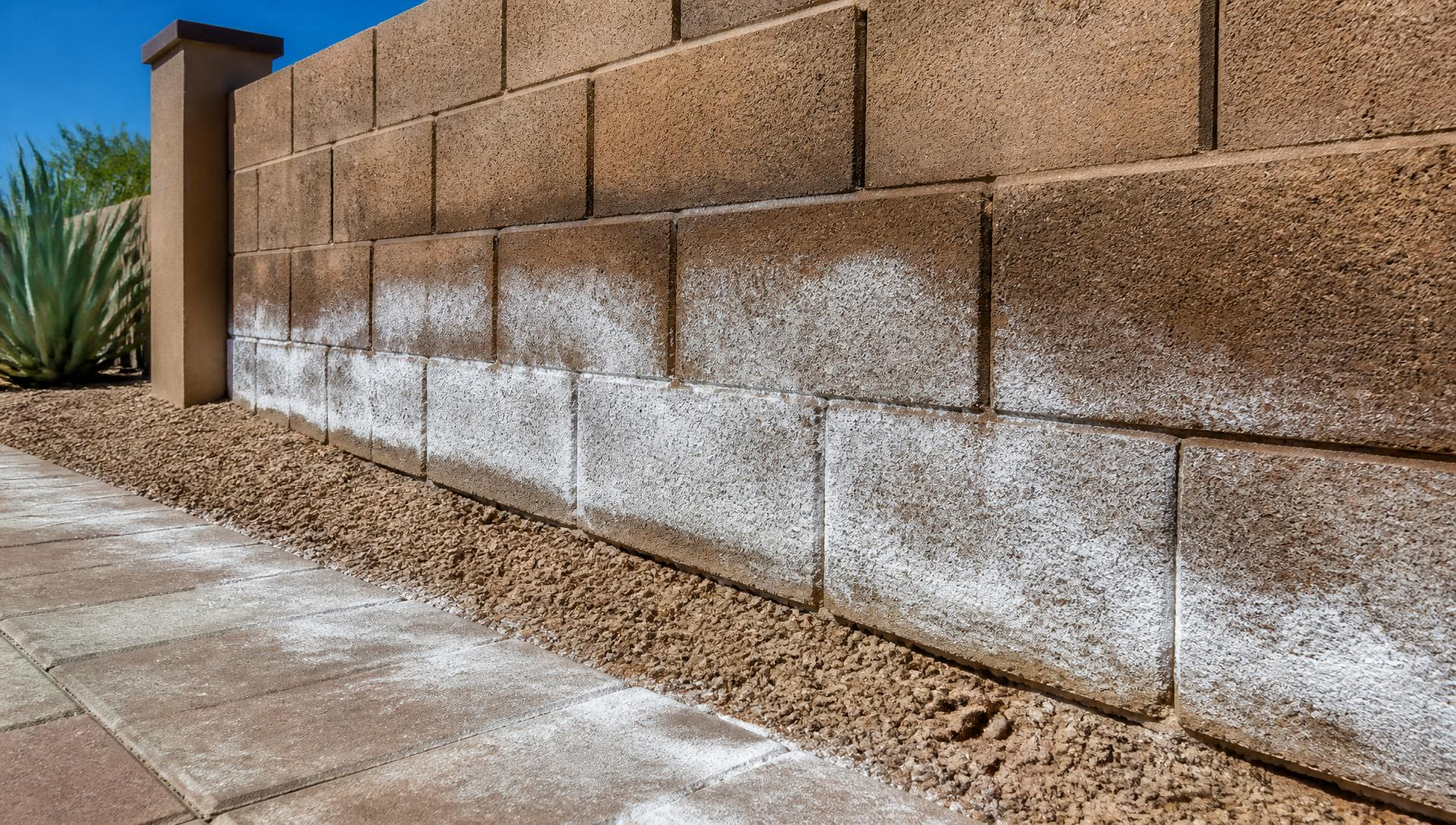
How to Remove Efflorescence in Phoenix: Block, Paver & Stucco Guide (2026)
How to Remove Efflorescence from Block Walls, Pavers, and Stucco: What Works and What Makes It Worse
If white, chalky deposits keep appearing on your block wall, pavers, stucco, brick, or pool deck, cleaning the surface is only half the solution. Efflorescence forms when moisture carries mineral salts through masonry and leaves them behind as the water evaporates. The right removal method depends on the surface, the severity of the deposit, and where the moisture is coming from.
You noticed it after the sprinklers ran, or after the first real monsoon rain of the season. A white, chalky, almost frost-like film spread across the bottom of the block wall, bloomed across a section of pavers, or ghosted across the stucco near a downspout. You wiped it, and some of it came off on your hand. A week later it was back.
That is efflorescence, and it is one of the most common surface complaints in the Phoenix Valley. It is also one of the most commonly mishandled. Advice online often sends property owners straight to vinegar, acid, or a pressure washer, even though those methods can permanently change certain masonry surfaces.
This guide explains what efflorescence actually is, why Arizona conditions produce so much of it, which removal methods hold up, and when professional pressure washing, soft washing, or media blasting may be more appropriate.
In This Guide
- What efflorescence actually is
- Why it is so common in Arizona
- How to identify efflorescence correctly
- Whether efflorescence is harmful
- DIY removal methods compared
- Why vinegar and acid can backfire
- Professional cleaning methods
- Surface-specific treatment options
- How to stop efflorescence from returning
- When to call a professional
- Frequently asked questions
What Efflorescence Actually Is
Efflorescence is a salt deposit, not dirt, mold, or paint failure. Concrete block, mortar, brick, pavers, and stucco all contain naturally occurring soluble mineral salts. When water gets into the masonry, it dissolves those salts and carries them along as it travels.
When that water reaches the surface and evaporates, the water leaves as vapor while the dissolved salts remain. Those salts crystallize on the face of the material, creating the familiar white or grayish powdery bloom.
There is also a related and more destructive condition called subflorescence. Instead of crystallizing on the surface, salts form inside the masonry pores. As those crystals expand, they can contribute to flaking, pitting, and crumbling. At that point, the issue has moved beyond simple cleaning and into surface repair.
Why Efflorescence Is So Common in Arizona
Homeowners in wetter climates may see efflorescence occasionally. In the Phoenix Valley, several local conditions make repeated mineral deposits much more common.
Hard Water
Municipal water throughout the Phoenix area contains substantial dissolved minerals. Irrigation, sprinkler overspray, and pool splash can continually add calcium and salts to masonry surfaces.
Irrigation and Sprinkler Overspray
A sprinkler head that repeatedly sprays a block wall or paver surface creates a steady wet-and-dry cycle. On residential block walls, this is one of the most common causes of recurring efflorescence.
Porous Block Wall Construction
Concrete masonry unit walls are common throughout the Valley. Hollow-core block readily absorbs moisture, especially when water enters through an unsealed cap, cracked top course, open mortar joint, or surrounding soil.
Monsoon Moisture and Rapid Evaporation
Heavy monsoon rainfall can saturate masonry quickly. Extreme Arizona heat then pulls the moisture back toward the surface, creating ideal conditions for salt crystallization.
New Construction Moisture
Fresh concrete, block, mortar, and newly installed pavers contain substantial construction moisture. Some early blooming during the first several months is normal while that moisture works its way out.
Pool Decks and Splash Zones
Repeated wetting and drying around pools can create especially heavy deposits. Pool chemistry and mineral-rich water can also contribute to hardened calcium scale alongside normal efflorescence.
Is It Efflorescence, or Is It Something Else?
The correct removal method depends entirely on what you are actually looking at. Misidentifying the deposit can lead to unnecessary pressure washing, acid exposure, or treatment that damages the surface without fixing the real problem.
| What You See | Most Likely Cause | The Tell |
|---|---|---|
| White powdery bloom that wipes or brushes off dry | Efflorescence | The powder comes away on your hand and often returns after rain or another irrigation cycle. |
| Hard white crust that resists brushing | Calcium scale or hardened efflorescence | It feels more like rock than powder and often appears around pool edges, splash zones, or drip lines. |
| Dark green, gray, or black patches | Mold, mildew, or algae | It typically develops in shaded damp areas and tends to smear rather than turn to powder. |
| Faded or dusty film on painted surfaces | Paint chalking | The residue usually matches the paint color and covers the painted surface more evenly. |
| Flaking, pitting, or crumbling surface | Spalling or internal salt damage | Material is actually breaking away from the wall or surface instead of simply resting on top. |
Is Efflorescence Harmful?
On its own, a light efflorescence deposit is primarily cosmetic. A single bloom on new concrete, block, stucco, or pavers does not automatically indicate a defect.
What matters is what repeated efflorescence tells you. A wall that develops the same bloom season after season is being repeatedly exposed to moisture. Long-term saturation can contribute to mortar deterioration, spalling block faces, paint or stucco delamination, and other moisture-related problems.
DIY Efflorescence Removal Methods, Honestly Rated
Different cleaning methods affect masonry very differently. The safest approach is generally to begin with the least aggressive option that can reasonably address the deposit.
| Method | What It Actually Does | Risk to the Surface | When It Falls Short |
|---|---|---|---|
| Dry brushing with a stiff bristle brush | Removes loose surface crystals without introducing more moisture. | Very low. Usually the safest first attempt. | Will not remove hardened mineral crust or years of heavy deposits. |
| Plain water rinse | Dissolves and carries away light salt residue. | Low, although it introduces additional moisture. | The added water can contribute to another bloom as the surface dries. |
| White vinegar solution | Mild acid dissolves some carbonate deposits. | Moderate. It can etch pavers, dull sealed surfaces, or lighten colored masonry. | Weak on heavy deposits and does not correct the moisture source. |
| Muriatic acid | Aggressively dissolves mineral crust and the cementitious surface around it. | High. It can burn masonry, open pores, strip color, damage landscaping, and corrode nearby metal. | May leave permanent burn shadows and make future moisture absorption easier. |
| Commercial efflorescence remover | Uses buffered masonry-safe chemistry designed to dissolve mineral deposits. | Low to moderate when the product is correctly matched and diluted. | The wrong cleaner can still etch, and no cleaner solves an active moisture source. |
| High-PSI pressure washer | Physically blasts deposits from the surface. | High on stucco, older block, mortar joints, and pavers. | Can force water deeper into masonry, erode texture, and contribute to rapid recurrence. |
| Professional soft washing | Uses masonry-safe chemistry, dwell time, and low-pressure rinsing. | Low when properly matched to the substrate. | May not be aggressive enough for years of hardened mineral scale. |
| Media blasting | Mechanically removes hardened deposits using selected abrasive media. | Low in trained hands when media and pressure are correctly matched. | Usually unnecessary for a light seasonal bloom. |
Why Vinegar and Acid So Often Backfire
Acid is appealing because mineral deposits can disappear quickly on contact. The problem is that the visible reaction does not necessarily mean the masonry was cleaned safely.
Etching
Acid does not distinguish perfectly between the mineral deposit and the cement paste that forms the masonry surface. On pavers and colored block, that can leave a dulled, lightened, roughened, or mottled finish.
Increased Porosity
An etched masonry surface is more open. Increased porosity can allow water to enter and leave the material more easily, potentially encouraging future mineral migration.
Burn Shadows
Uneven acid application, runs, drips, and splashes can produce lighter streaks or blotches. Once the masonry itself has changed color, another rinse generally will not restore it.
Salt Migration
Applying liquid treatment to very dry, absorbent masonry can carry dissolved material deeper into the pores. As the wall dries, salts can migrate back toward the surface again.
Collateral Damage
Strong acid runoff can damage landscaping, corrode gate hardware and nearby metals, affect pool equipment, and create significant handling and respiratory hazards.
How Professionals Remove Efflorescence
A professional approach separates the deposit from the substrate instead of simply attacking everything with maximum pressure or the strongest available chemical. The appropriate method depends on how hardened the deposit is and what type of surface lies underneath.
Soft Washing
Soft washing uses masonry-appropriate chemistry, controlled dwell time, and low-pressure rinsing. The cleaning chemistry performs most of the work so excessive water pressure is not needed.
This is often the preferred starting point for stucco, painted block, and textured surfaces that could be damaged by aggressive pressure washing.
Low-Pressure Chemical Treatment
Moderate deposits on raw block, brick, and pavers may respond to a buffered masonry cleaner matched to the substrate, applied to a properly prepared surface and fully rinsed afterward.
Substrate matching matters. A product appropriate for raw concrete block may not be appropriate for colored pavers, sealed masonry, or natural stone.
Media Blasting
When deposits have hardened over multiple seasons or are combined with heavy calcium scale, chemical treatment alone may no longer be efficient.
Controlled media blasting can mechanically remove hardened mineral buildup, with the abrasive material and pressure selected for the surface underneath.
Efflorescence Removal by Surface Type
The same white mineral deposit can require a very different cleaning approach depending on whether it appears on raw block, stucco, pavers, brick, or a pool deck.
| Surface | Typical First Approach | Important Consideration |
|---|---|---|
| Raw concrete block | Dry brushing followed by controlled masonry-safe chemical treatment. | Raw block generally tolerates treatment better than finished surfaces and may be a candidate for blasting when buildup becomes severe. |
| Stucco | Soft washing and gentle chemistry. | Stucco texture can be permanently damaged by excessive pressure or aggressive acid. |
| Pavers | Surface-compatible chemical treatment with a controlled rinse. | Avoid cleaning methods that strip joint sand or alter the paver color. |
| Brick | Gentle cleaning first. | Older brick can have a softer fired face that aggressive cleaning may permanently remove. |
| Pool decks and waterline areas | Determine whether the deposit is efflorescence, calcium scale, or a combination. | Heavy hardened scale may require specialty surface restoration or controlled blasting. |
Miracle Maintenance provides pressure washing, soft washing, sandblasting, media blasting, and specialty surface-restoration services throughout Phoenix and the surrounding Valley.
How to Stop Efflorescence from Coming Back
Cleaning is the visible half of the job. Cutting off unnecessary water exposure is the part that determines whether the white bloom returns again next season.
- Fix the irrigation first. Run the sprinkler system and redirect every head that sprays directly onto block walls, stucco, pavers, brick, or other masonry.
- Correct drainage problems. Grade soil away from wall footings, keep roof runoff moving away from masonry, and avoid areas where water continually pools against block.
- Cap and seal the top course. An open, cracked, or poorly protected wall cap can let rainwater enter hollow block cores and migrate downward through the wall.
- Repoint failing mortar joints. Open mortar joints create direct moisture entry points and may explain why efflorescence is concentrated in one particular section.
- Let new masonry finish curing. New block, concrete, and pavers need time for construction moisture to escape before sealing.
- Seal only after cleaning and drying. A compatible breathable masonry sealer can reduce future water absorption, but it should only be applied after the active bloom and moisture source have been addressed.
When to Call a Pro Instead of Chasing It Yourself
A light powdery bloom on an ordinary back wall may only require dry brushing and correction of the nearby water source. More difficult conditions deserve a professional evaluation before aggressive cleaning changes the surface permanently.
- The mineral deposit is hard, thick, and does not respond to dry brushing.
- The bloom has returned in the same location over multiple seasons.
- The affected surface is stucco, painted, colored, sealed, decorative, or natural stone.
- You are seeing flaking, pitting, soft material, or crumbling along with the white deposit.
- The affected area is a commercial property, HOA wall, storefront, or another highly visible surface where uneven cleaning would be difficult to hide.
- Efflorescence is mixed with hardened calcium scale around a pool deck or waterline.
- A previous vinegar, acid, or pressure-washing attempt has already changed the color or texture of the masonry.
Frequently Asked Questions
What is efflorescence?
Efflorescence is a white or grayish crystalline deposit that forms when water moves through masonry, dissolves naturally occurring salts inside the material, carries them to the surface, and then evaporates. The water leaves while the salt remains behind as a powdery bloom.
Is efflorescence harmful?
The deposit itself is primarily cosmetic and is not considered a health hazard. What it indicates can matter. Persistent efflorescence means water is repeatedly moving through the masonry, and long-term saturation can contribute to spalling, mortar deterioration, paint failure, and other moisture-related damage.
Think of recurring efflorescence as a moisture report rather than simply a stain.
Will vinegar remove efflorescence?
Sometimes it can lighten relatively minor mineral deposits because vinegar is a weak acid. The downside is that acidic treatment can also etch masonry, dull or lighten pavers and colored block, and affect certain sealers or finishes.
Vinegar also does not correct the water source that caused the salts to migrate to the surface, so the bloom may return.
Why does efflorescence keep coming back after I clean it?
Because cleaning removes the visible salt deposit rather than the moisture path. As long as water continues entering through sprinkler overspray, irrigation, poor drainage, an open wall cap, a leaking joint, rain, or pool splash, additional salts can migrate toward the surface.
How do I remove efflorescence from pavers?
Start with dry brushing when the pavers are completely dry. For heavier deposits, use a masonry-safe efflorescence cleaner specifically compatible with the type and finish of the paver and follow the manufacturer’s application and rinse instructions.
Avoid excessive pressure that can strip joint sand or permanently change the appearance of the paver surface. Correct sprinkler overspray or other moisture sources before resealing.
Can I seal over efflorescence?
No. The surface should first be cleaned, the moisture source corrected, and the masonry allowed to dry appropriately. Applying sealer over active salts or trapped moisture can contribute to a cloudy, blotchy, or peeling finish.
How long does it take for new masonry to stop efflorescing?
New block, concrete, mortar, and pavers commonly develop some efflorescence during the first several months as construction moisture leaves the material. This can continue intermittently for roughly the first year depending on the installation and moisture exposure.
If significant blooming continues well beyond the initial curing period, an ongoing source of water may be entering the masonry.
Efflorescence That Keeps Coming Back?
Removing the white deposit is only part of the solution. Lasting results come from identifying the material, choosing a cleaning method appropriate for that surface, and correcting the moisture path that keeps carrying salts back toward the face.
Miracle Maintenance handles efflorescence, calcium scale, and mineral staining on block walls, pavers, brick, stucco, concrete, pool decks, and other masonry surfaces throughout Phoenix and the surrounding Valley.
Our team uses professional pressure washing, soft washing, controlled masonry cleaning, sandblasting, and media blasting depending on the deposit and the surface underneath.
If the bloom is hardened, repeatedly returning, or sitting on a surface you do not want to risk damaging, professional treatment may be a better option than another aggressive DIY cleaning attempt.
Miracle Maintenance Inc. serves Phoenix, Scottsdale, Mesa, Tempe, Chandler, Gilbert, Glendale, Peoria, and the surrounding Valley with pressure washing, soft washing, media blasting, and surface-restoration services.



No Comments
Sorry, the comment form is closed at this time.