


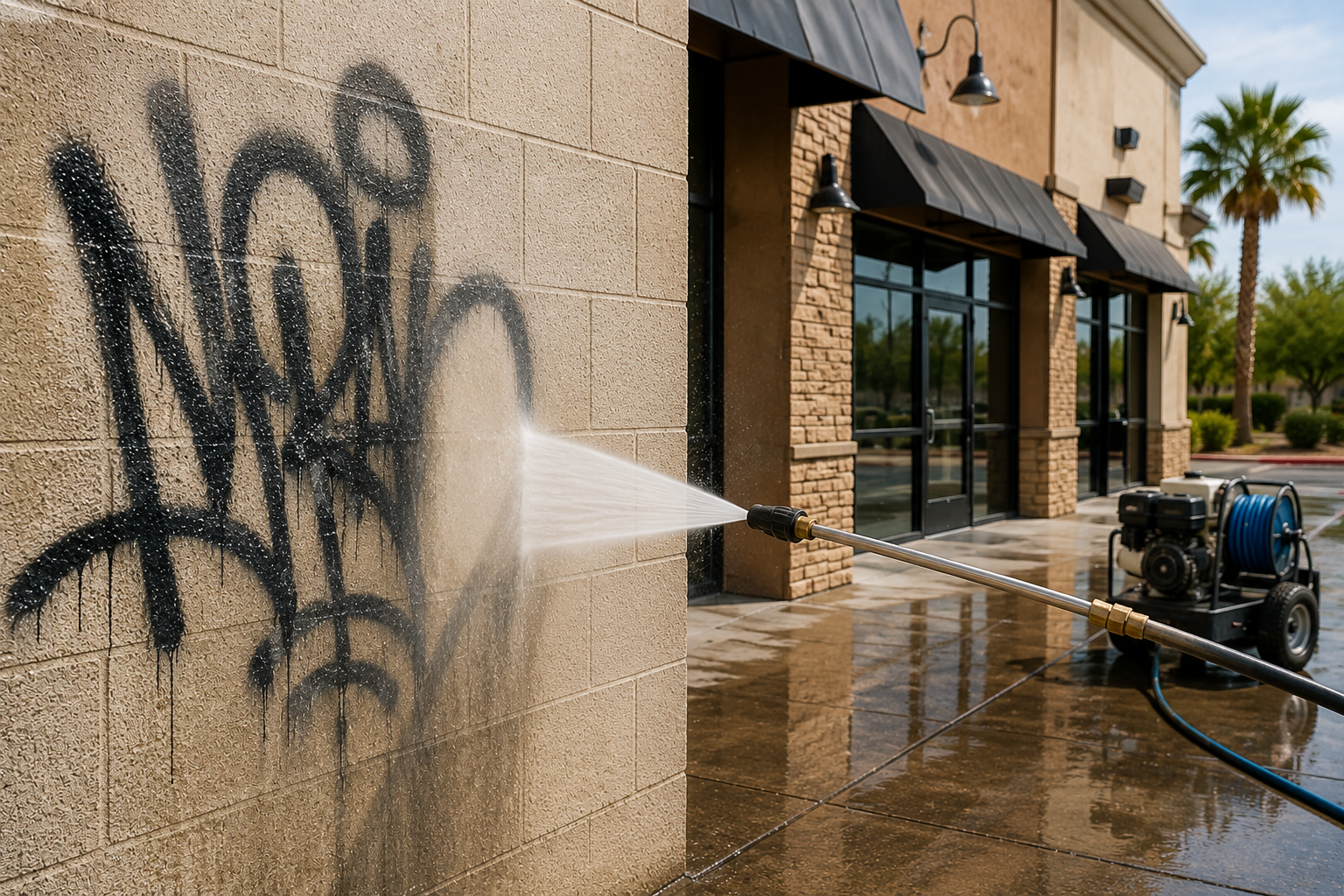
How to Remove Graffiti From Commercial Buildings in Phoenix: Methods, Surfaces & What Property Managers Should Know
Commercial Graffiti Removal in Phoenix: Pressure Washing, Media Blasting, and Surface Restoration
Graffiti on a commercial property creates more than a cosmetic problem. For property managers
and business owners in Phoenix, the challenge is removing paint, marker, or other coatings
without damaging the concrete, stucco, brick, metal, or painted surface underneath.
There is no single graffiti-removal method that works safely on every building material.
The key is matching the removal process to the surface.
By the Miracle Maintenance team, Phoenix, Arizona. Commercial pressure washing,
hot-water cleaning, media blasting, sandblasting, painting, staining, and specialty surface restoration.
Miracle Maintenance has provided commercial cleaning and surface-restoration services in Arizona
for more than 25 years. Graffiti removal should be approached as surface restoration rather than
maximum-pressure cleaning.
Depending on the project, professional removal may involve
controlled pressure washing,
hot water, appropriate cleaning agents,
media blasting,
sandblasting,
repainting, staining, or a combination of methods.
In This Guide
- What to do when graffiti appears
- Why the surface determines the method
- Pressure washing vs. media blasting
- Common graffiti-removal mistakes
- Concrete, stucco, and painted surfaces
- Commercial-property considerations
- Property-manager response checklist
- Frequently asked questions
What Should You Do When You Find Graffiti on Your Commercial Property?
Before reaching for a pressure washer or chemical cleaner, evaluate the affected area.
A practical first response helps protect the surface and gives the contractor better information.
Document the Graffiti
Photograph the affected area before cleaning, especially when the property has security procedures or incident-reporting requirements.
Identify the Surface
Concrete, brick, stucco, painted walls, metal, block, and stone respond differently to pressure, heat, chemistry, and blasting media.
Look at the Coating
Spray paint, marker, overspray, and other coatings may require different removal methods.
Avoid Aggressive DIY Treatment
Excessive pressure or an incompatible cleaner can permanently alter the substrate and increase restoration costs.
Test When Appropriate
An inconspicuous test area can show how the substrate and coating respond before the full area is treated.
Evaluate the Finished Surface
Removal should address the graffiti without unnecessarily altering the surrounding finish.
It is to remove the unwanted coating while preserving as much of the original surface as possible.
Why Graffiti Removal Depends on the Surface
A method that works well on durable concrete could damage painted stucco or another sensitive finish.
Surface identification should happen before cleaning begins.
| Surface | Primary Concern | Possible Starting Approach | What to Protect |
|---|---|---|---|
| Concrete | Porosity, embedded paint, etching risk | Controlled pressure, heat, chemistry, or specialty removal | Surface profile and surrounding appearance |
| Brick / Block | Mortar joints, porous texture, ghosting | Controlled pressure, chemistry, or blasting where appropriate | Mortar, face texture, and original color |
| Stucco | Texture damage and coating loss | Gentler cleaning or refinishing | Texture and painted finish |
| Painted Wall | Stripping the base coating | Test cleaning, spot removal, or repainting | Existing coating and color match |
| Metal | Coating compatibility and corrosion | Cleaning, blasting, and recoating as needed | Substrate and corrosion protection |
Can You Pressure Wash Graffiti Off?
Sometimes—but pressure alone is not the answer. Professional pressure washing depends on pressure,
operator knowledge, equipment, cleaning agents, and water temperature.
Pressure
Excessive force can etch concrete, affect mortar, damage coatings, or alter delicate finishes.
Temperature
Hot water can improve removal in difficult applications and may reduce the need for aggressive pressure.
Chemistry
Cleaning agents should be selected for both the graffiti material and the underlying substrate.
Technique
Distance, angle, dwell time, rinse pattern, and surface knowledge all affect the final result.
Pressure Washing vs. Media Blasting for Graffiti Removal
Pressure washing is only one potential approach. Miracle Maintenance also provides
media blasting, sandblasting, soda blasting, painting, staining, and specialty restoration.
| Method | Best Fit | Main Advantage | Main Consideration |
|---|---|---|---|
| Pressure Washing | Durable surfaces where the coating can be released with water, heat, or chemistry | Efficient cleaning across broader areas | Excessive pressure can damage the substrate |
| Hot-Water Cleaning | Stubborn coatings that respond to heat | Can improve cleaning without increasing pressure | Still requires surface compatibility |
| Media Blasting | Coatings or contamination bonded into the surface | Mechanical surface preparation and removal | Media selection must protect the substrate |
| Repainting / Refinishing | Painted walls where cleaning alone will not restore appearance | Can restore a uniform finished surface | Proper surface preparation is still required |
When Is Media Blasting a Better Option?
Media blasting uses abrasive or specialized media propelled against a surface to remove coatings,
contamination, corrosion, or other unwanted material. It is not automatically better than pressure washing;
it is another tool for situations where a different level or type of surface preparation is required.
- Graffiti ghosting remains on porous masonry after conventional cleaning.
- A coating is bonded too deeply for safe water-based removal.
- Metal or structural surfaces need coating removal and preparation for refinishing.
- The project involves heavier industrial or specialty restoration.
- The next coating requires a particular surface profile for adhesion.
Common Graffiti Removal Mistakes
Using Maximum Pressure
A pressure washer is not an eraser. Aggressive pressure can affect the substrate itself.
Assuming Every Cleaner Works on Every Surface
A chemical that breaks down one coating may stain, soften, or damage another surface.
Treating Stucco Like Concrete
Textured or painted surfaces require different treatment than durable flat concrete.
Skipping a Test Area
A small test section can reveal compatibility problems before the entire surface is treated.
Leaving a Visible Outline
Weathering, dirt, previous coatings, or cleaning can leave contrast after the graffiti itself is removed.
Painting Over Poor Surface Preparation
Loose material, contamination, or incompatible coatings can affect the finished result.
What About Graffiti on Concrete?
Concrete is common throughout Phoenix commercial properties, including sidewalks,
parking structures, loading areas, dumpster pads, walls, and other exterior surfaces.
Because concrete is porous, paint can extend into surface pores rather than sitting entirely on top.
- Type of paint or marking.
- Age of the graffiti.
- Concrete condition.
- Previous coatings or sealers.
- Surface texture.
- Whether heat or cleaning agents are appropriate.
- Whether pressure washing can achieve the desired result.
This also creates a natural connection between graffiti removal and routine
commercial pressure washing
for sidewalks, parking areas, and other high-traffic surfaces.
What About Graffiti on Stucco or Painted Walls?
Stucco and painted surfaces require additional care because the finish itself can be affected during removal.
- Whether the stucco is painted.
- Condition of the existing coating.
- Texture of the surface.
- Type of graffiti.
- Whether removal will affect the underlying finish.
- Whether cleaning or refinishing provides the better result.
Graffiti Removal for Phoenix Commercial Properties
Different commercial environments create different access, scheduling, and surface-cleaning requirements.
- Commercial buildings
- Retail centers
- Parking structures
- Restaurants
- Apartment communities
- Schools
- Industrial properties
- High-traffic exterior areas
Property managers should be prepared to identify the graffiti location, approximate size,
surface material, access conditions, and any scheduling requirements.
Why Professional Experience Matters
Graffiti removal involves more than owning a pressure washer. The operator needs to understand how
pressure, heat, cleaning agents, equipment, surface materials, and coatings interact.
Miracle Maintenance has provided commercial cleaning and surface-restoration services in Arizona
for more than 25 years. The company’s work includes pressure washing, media blasting, painting,
staining, and specialized restoration.
Its documented project history includes industrial work at the Circle K tank farm in Phoenix,
where media blasting was performed on two fuel tanks with a combined capacity of approximately four million gallons.
- AZROC 296901 — Mobile Sandblasting
- AZROC 340099 — Painting & Staining
A Practical Graffiti Response Checklist for Property Managers
- Document the affected area.
- Identify the surface material.
- Determine whether the surface is painted, coated, sealed, or unfinished.
- Avoid immediately applying an unknown chemical.
- Avoid assuming maximum pressure is the right answer.
- Note approximate size and accessibility.
- Identify scheduling limitations caused by tenants or business operations.
- Select the removal or restoration method by surface.
- Evaluate the surface after removal.
- Determine whether additional cleaning, coating, or refinishing is necessary.
Why Prompt Graffiti Removal Matters for Commercial Properties
Graffiti affects customer-facing walls, storefronts, parking structures, block walls,
and other visible areas. Addressing it promptly also gives the property manager an opportunity
to inspect the underlying surface and determine whether cleaning alone will restore it.
and stucco building exterior should not automatically receive identical treatment.
Frequently Asked Questions
Can graffiti be pressure washed off concrete?
Pressure washing may be appropriate for some concrete surfaces, but the correct approach depends on the paint, concrete condition, porosity, equipment, temperature, cleaning agents, and pressure being used.
How do professionals remove graffiti from stucco?
The first step is identifying the stucco finish and determining whether it is painted or coated. Because aggressive cleaning can affect the finish, the method should match both the surface and graffiti material.
Can graffiti be removed without damaging the paint underneath?
Sometimes. The result depends on the graffiti material, underlying coating, age and condition of the paint, and removal method. Testing an inconspicuous area can help determine how the finish will respond.
What is the difference between pressure washing and media blasting?
Pressure washing uses pressurized water, sometimes with heat and cleaning agents. Media blasting propels a selected abrasive or other medium against a surface to remove coatings or prepare the material.
Should you remove graffiti before repainting?
Surface preparation is important before applying a new coating. Depending on the wall and graffiti, cleaning, removal, or other preparation may be necessary before repainting.
Does Miracle Maintenance provide commercial graffiti removal in Phoenix?
Yes. Miracle Maintenance provides commercial pressure washing and surface-restoration services in the Phoenix area, including graffiti removal, pressure washing, media blasting, painting, staining, and specialty cleaning.
Commercial Graffiti Removal in Phoenix, AZ
Miracle Maintenance provides commercial cleaning and surface-restoration services throughout the Phoenix area.
With capabilities that include pressure washing, hot-water cleaning, media blasting, sandblasting,
soda blasting, painting, staining, and specialty restoration, the team can evaluate the affected material
and determine an appropriate approach for the project.
For property managers, business owners, facility managers, and HOAs, the goal should be more than
removing visible paint. It should be restoring the affected area while protecting the surface underneath.



No Comments
Sorry, the comment form is closed at this time.